Most people shopping for a smoother head shave assume the problem is their shaver. Often it isn't. The same foil or rotary head will leave stubble on one pass and glass-smooth skin on the next depending on one thing you rarely think about: how you hold it. Learning how to hold a head shaver — the grip, the angle, and the amount of pressure — fixes more missed spots, irritation, and uneven patches than any gadget swap. It takes about one shave to retrain your hand, and the results are immediate.
Why your grip changes the shave
A head shaver only cuts cleanly when the cutting surface sits flat against your scalp. Your scalp is curved in every direction, so the shaver has to be steered to follow those curves. If you grip the handle too tightly or hold it like a pen, your wrist locks up and the head rocks onto one edge, so only part of the foil touches skin. That's where stubble lines and shadow come from. A loose, mobile grip lets the head float and stay flush, which is the whole point of a modern floating head.
How to hold a head shaver: grip and hand position
Hold the shaver in a relaxed palm grip, the way you'd hold a TV remote, not pinched in your fingertips. Let the weight of the tool rest in your hand and keep your wrist loose so it can roll as you move across the dome of your head. Your fingers should rest lightly on the sides of the body, never clamped. A good test: if your knuckles are white or your forearm is tense after a minute, you're gripping too hard. Ease off and let the shaver do the work — it's motorized, and your job is only to guide it and keep it flat.
The right angle for foil vs rotary
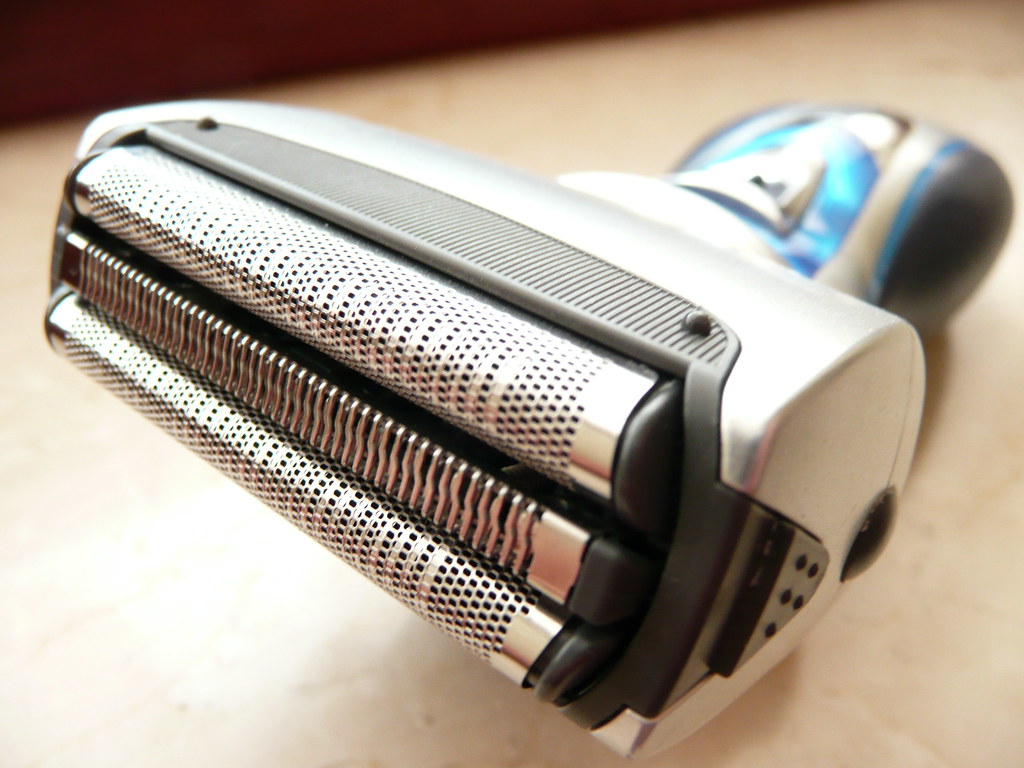
Angle depends on the type of head. A foil shaver cuts best held flat, with the full foil pressed evenly against the scalp — keep it as close to 90 degrees (perpendicular) to the skin as the curve allows, and glide in short straight strokes against the direction of growth. A rotary shaver works at a slightly tilted angle, with the three spinning heads laid flat and moved in slow overlapping circles. If you're getting a rough cut, the usual culprit is tilting a foil up onto its edge or mashing a rotary straight down. Lay the head flat, follow the contour, and let every part of the cutting surface reach the hair.
Pressure: lighter than you think
This is the step almost everyone gets wrong. Pressing hard feels like it should cut closer, but it does the opposite. Firm pressure flattens your skin down below the foil, so the blades skim over the hair instead of catching it, and it drags and irritates the scalp — the leading cause of redness, razor bumps, and that burning feeling afterward. Use just enough contact to keep the head touching skin, roughly the weight of the shaver itself. If you see your scalp blanching white or feel heat building, you're pushing too hard. Let the motor and a flat head do the cutting; your hand only provides direction and light, steady contact.
Work in sections and use your free hand
Divide your head into zones — front, both sides, crown, and back — and finish one before moving on. Overlap each stroke by about half the head's width so you never leave a gap, and make a second pass across the grain only after the first pass is complete. Your free hand matters as much as your shaving hand: use it to stretch the skin taut on softer areas like the nape and around the ears, which lifts the hair up into the blades and keeps the surface flat. Taut skin plus a flat head is the combination that clears stubble in one or two passes instead of five.
Reaching the crown and back of your head
The back and crown are where grip and angle fall apart, because you can't see them and your wrist wants to twist into an awkward position. Keep the same loose grip, drop your elbow so your forearm does the reaching instead of cranking your wrist, and go slowly in short strokes by feel. Run your free hand over each zone afterward — your fingertips will find rough patches your eyes miss. A lightweight, well-balanced shaver makes this far easier, which is one reason the right tool still matters. If you're weighing options, our guide to the best head shavers for men breaks down which heads stay flattest on the curves of your scalp.
Dial in these three things — a relaxed grip, a flat head held at the right angle, and feather-light pressure — and most of the problems people blame on their shaver simply disappear. Give it one full shave to feel natural, and keep your free hand working alongside the shaving hand. You'll get a closer, more comfortable result with less irritation and far fewer missed spots.
Ready for the smoothest shave?
Our #1-ranked head shaver — the Exoshave 7D — is 50% off today. Its floating 7D head follows every curve of your scalp and stays flat where cheaper shavers tip onto their edge, so a light, relaxed grip is all it takes for a clean, nick-free finish.
See the #1 pick →