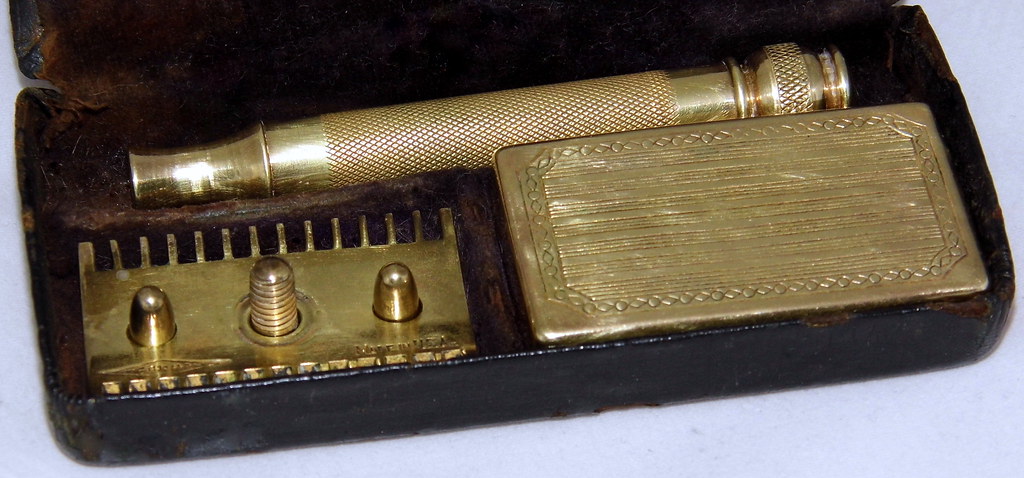
A double-edge safety razor is the old-school way to get a mirror-smooth scalp for a few cents a blade. It shaves closer than most cartridge razors and, once you learn the angle, it's gentler too. But a safety razor is also less forgiving than a cartridge or an electric, so learning to shave your head with a safety razor is mostly about technique: soft hair, a light touch, and a blade held at the right angle. Get those three things right and nicks become rare.
Is a safety razor right for your head?
A safety razor exposes a single sharp blade with no pivoting head and no lubricating strip. That gives you a very close, clean cut and cheap refills — blades cost roughly ten to twenty cents each versus two to four dollars for a cartridge. The trade-off is reach and feedback: the back and crown of your skull are curved surfaces you can't see, and a fixed blade won't flex to follow them. If you have deep scars, a lot of moles, or shaky hands, a pivoting cartridge or an electric head shaver is the safer bet. If you like the ritual of a wet shave and want the closest result for the least money, a safety razor is hard to beat.
What you need
Keep it simple: a double-edge safety razor, a pack of blades (buy a sampler — brands cut differently and your scalp will prefer one), a shaving soap or cream, a brush to build lather, and a styptic pencil or alum block for any weepers. A second handheld mirror lets you check the back. That's the whole home shaving kit — nothing fancy.
How to shave your head with a safety razor, step by step
1. Soften the hair first. Shave right after a hot shower, or press a hot, wet towel over your scalp for two minutes. Warm, hydrated hair cuts far more easily than dry stubble, which is where most irritation starts. If your hair is longer than a few millimetres, clip it down first — a safety razor is for finishing, not for mowing through length.
2. Build a real lather. Load the brush and work the soap into a slick, cushiony lather directly on your head. Good lather is your slip layer; skimping on it is the fastest route to razor burn. Re-lather every section before you shave it, not just once at the start.
3. Find the 30-degree angle. This is the whole game. Lay the razor's head flat against your scalp so the handle points straight out, then tip the handle down until the blade just begins to bite — that's roughly a 30-degree angle between the blade and your skin. Too steep and it scrapes; too flat and it skips. Let the weight of the razor do the cutting.
4. No pressure, short strokes. Never press. Use short, slow strokes of an inch or two and let the blade glide. Shave the top and sides first where you can see, rinsing the blade under hot water every few strokes so it never clogs.
5. Map your grain and go with it first. Hair on the scalp changes direction — often forward on top, down at the sides, and swirling at the crown. Rub a dry palm around your head to feel which way each patch grows. Make your first full pass with the grain. If you want it closer, re-lather and make a second pass across the grain. Going straight against the grain on a first pass is what causes most ingrown hairs and bumps.
6. Work the back by feel. You can't see the back of your head, so go slowly and use your free hand to feel for stubble and track where you've already shaved. Keep the same light angle, and use the handheld mirror to spot-check before you rinse off. A reliable technique here matters more than any gadget, which is also why the best head shaver roundups lean toward tools that reach the back easily.
Aftercare and nicks
Rinse with cool water to close things up, then pat — don't rub — dry. Smooth on an alcohol-free balm or a light moisturizer to calm the skin, and add SPF before you go outside; a freshly shaved scalp burns fast. If you catch a nick, press a styptic pencil or a wet alum block on it for ten seconds and it will stop. Swap your blade every three to five shaves. A dull blade tugs instead of cutting, and tugging is what leaves you red and bumpy.
Expect a learning curve. Your first few scalp shaves with a safety razor may be a little patchy or tender as you dial in the angle and learn your grain map. By the fourth or fifth session, most people get a shave that's closer and more comfortable than anything a cartridge gave them — for a fraction of the running cost.
Want razor-close without the razor risk?
If reaching the back by feel sounds like work, our #1-ranked head shaver — the Exoshave 7D — has a floating magnetic head with seven blades that hug every curve of your skull, so even the spots you can't see come out even and bump-free. It's 50% off today.
See the #1 pick →